
Most Popular Forms used by Purchasing [3 free samples]

What are the Most Popular Forms used by Purchasing Professionals today?

In order to manage the need to purchase supplies and services, purchasing professionals turn to certain forms, templates or documents to obtain the internally requested products or services.

Some standard forms you might be familiar with include: Request for Quotation (RFQ), Request for Proposal (RFP), Request for Information (RFI), and  many others.

While most of these procurement forms are relatively straightforward, the RFP is a form that has continued to evolve since it first started to appear in the early ’80s. Since then, RFPs have become more prevalent, refined and in some cases are all many companies issue (not what we recommend!!). Regardless, companies that purchase goods and services need procurement forms to help them manage their business. These forms are a necessary evil and ultimately will help you complete the task of getting to the stage for an award.

Work flow and players involved when you issue an RFP / RFQ

Before we detail the templates most used by purchasing professionals today, we think some background on the process would be helpful. Typically, there are 3 or 4 role players in the RFP or RFQ process. There is a Tenderer, aka, Bidder / Offeror / Supplier / Vendor (a seller of materials and/or supplies who submits a proposal or quotation against your requirements); then there is the Owner, which is the parent company issuing the document and paying the bills — the user or internal department making the request or the fellow employees needing the material or service to complete the project — and lastly the procurement officer, who is the person managing the RFP / RFQ. The procurement officer or purchasing agent often generate the documents, issues the RFP, analyzes the supplier quotes, makes a recommendation, and finally manages the award to the supplier of choice. There are others, like the accounting department, which will pay the supplier, and so on.

Now back to the most popular forms used today:

RFP – (Request for Proposal). Without question, this form is considered the go-to form for procurement professionals on larger dollar spend and when your selection criteria might use additional factors other than price, like service capabilities or technical support.

Free RFP Template is included in our Welcome Pack

RFQ – (Request for Quote). To some this is up for debate, but depending on the organization, sometimes the Buyer is simply looking for price and delivery on a simple material request.  We need six widgets and here is the part number, so in this instance an RFP is overkill and is not worth the cost or effort.

Free RFQ Template is included in our Welcome Pack

EOI or RFI – (Expression of Interest) or (Request for Information).  An EOI or RFI is used to gauge interest from potential suppliers for a potential upcoming project on the drawing board or hope to officially tender in the near future. An EOI gives you the opportunity to prequalify vendors to ensure they are capable of completing the work under the restrictions or specifications outlined in your document.

Free Simple RFI Template > 8 pages

LOI or LOU – (Letter of Intent) or (Letter of Understanding). Often the next document to be used by the purchasing department, if the spend warrants it, versus going right to a PO.  It captures the summary terms negotiated by both parties during the award process, and these details will eventually make their way into the formal contract. Simply put, the Buyer is looking for a document they can use to bridge them over until a formal contract document can be executed.

There are many documents a Buyer or Purchasing Agent relies on in their day‑to‑day purchasing activities. If you, like many of us, find the RFP process overwhelming or too time‑consuming, the RFQPro Step‑by‑Step RFP Guide will make your workflow significantly easier.

This new guide simplifies the entire RFP process by providing a clear, start‑to‑finish roadmap complete with sample forms used at each stage of issuing an RFP. All templates are delivered in fully editable Microsoft Word format, ensuring you can customize them to suit your organization’s needs.

As a bonus, this comprehensive guide and template pack will be offered at a discount to all subscribers, with additional savings for returning customers on top of the standard subscriber discount.
RFP Infographic

5 Steps from RFP to Award

Five key steps from issuing a Request for Proposal (RFP) to awarding the contract.

The Infographic below provides a clear, high-level summary of the typical chain of events that occur when issuing an RFP for a product or service.

Many organizations underestimate the complexity and time required to properly issue, evaluate, and award an RFP. Each step plays a critical role in ensuring a fair and successful process.

This visual guide to the five essential steps in the RFP-to-Award process is designed to offer practical insight on the process.  Hope it helps!

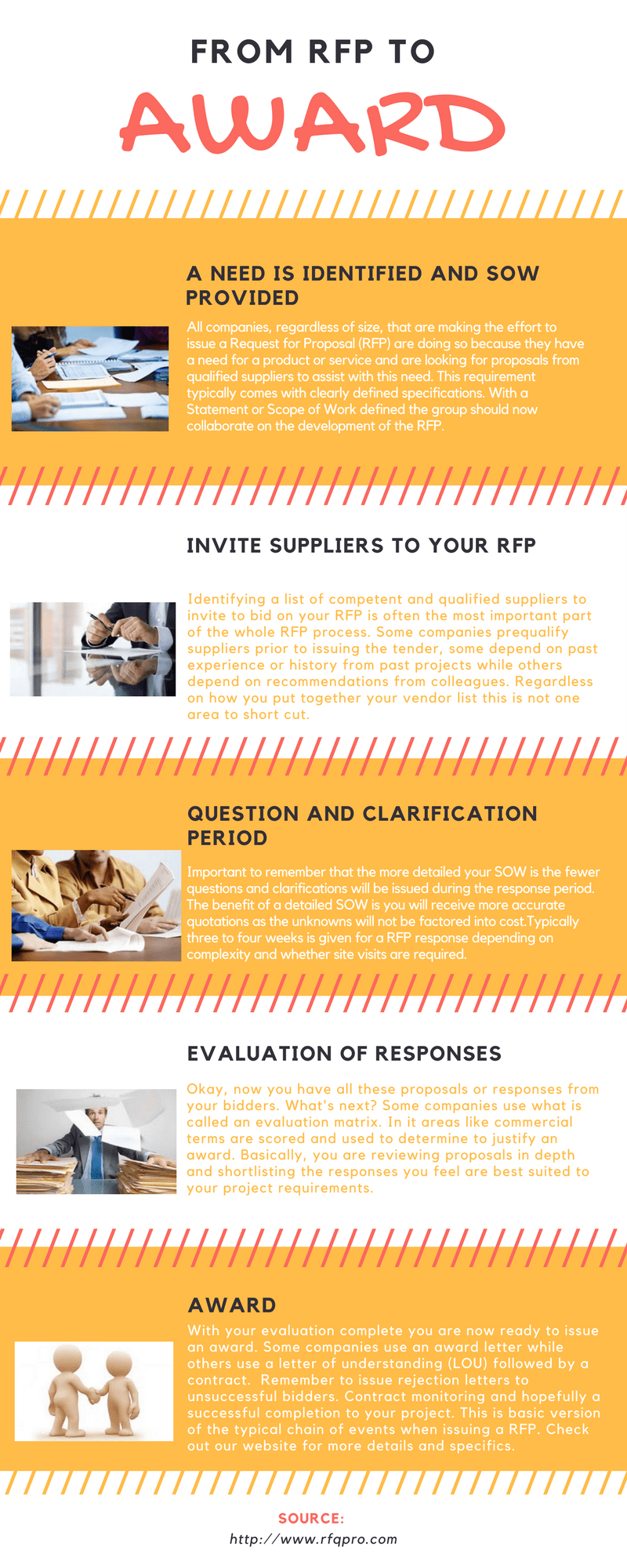
RFP Infographic5 Step Summary – FROM RFP TO AWARD

Step 1 – A need is identified, and Scope of Work (SOW) is provided.

All companies, regardless of size, that make the effort to issue a Request for Proposal (RFP) do so because they have a need for a product or service and are seeking proposals from qualified suppliers to address that need. This requirement typically comes with clearly defined specifications. With a Statement or Scope of Work established, the group should now collaborate on developing the RFP.

Step 2 – Invite suppliers to your RFP

Identifying a list of competent and qualified suppliers to invite to bid on your RFP is often one of the most important steps in the entire process. Some companies prequalify suppliers before issuing the tender, others rely on experience or performance from past projects, and many depend on recommendations from colleagues. Regardless of how you assemble your vendor list, this is not an area to shortcut.

Step 3 – Question and clarification period

It’s important to remember that the more detailed your SOW is, the fewer questions and clarifications will surface during the response period. A detailed SOW leads to more accurate quotations because unknowns are less likely to be factored into the cost. Typically, three to four weeks are allotted for an RFP response, depending on complexity and whether site visits are required.

Step 4 – Evaluation of responses

Now that you have all the proposals or responses from your bidders, what’s next? Many companies use an evaluation matrix, where areas such as commercial terms are scored and used to support the award decision. At this stage, you are reviewing each proposal in depth and shortlisting the responses that best align with your project requirements.

Step 5 – Award

With your evaluation complete, you’re ready to issue an award. Some organizations use an award letter and a purchase order (PO), while others prefer a letter of understanding (LOU) followed by a formal contract.

Award Approaches

  • Award Letter + PO — A straightforward method often used when the scope is well‑defined and standard terms apply. The PO serves as the binding document once accepted.
  • LOU + Formal Contract — Common for complex projects, multi‑year agreements, or situations where legal, commercial, or technical terms require detailed negotiation. The LOU confirms intent while the full contract is finalized.
  • Don’t forget to send rejection letters to unsuccessful bidders. After awarding, focus on contract monitoring to ensure smooth execution and, ideally, successful completion of your project.

This is a high-level overview of the typical steps involved in issuing an RFP. For more details on buyer and supplier solutions—including sample RFPs, response letters, and other useful forms—visit our website.

If you have found this information to be useful, please consider sharing this Infographic on the 5 steps from RFP to an Award.

Evaluating Spend

Evaluating your Spend

Evaluating Spend Every business, regardless of size,  should have a clear understanding on its operating costs and should be constantly evaluating this spend.

What Does It Mean to Evaluate Your Spend?

Evaluating spend means identifying where your money goes and whether you’re getting value. If you asked your accounting department to provide a list of the top 20% of vendors in relation to how much money you spend with them annually, this would be a start. This list of suppliers will represent close to 80% of your operating budget. I know, the Pareto principle is overused but in this instance is 100% on point.

Focus on the 80% That Drives Your Costs

Prudent business owners will dedicate a large portion of their time or their purchasing department’s time on analyzing this 80% cost. These are your target vendors and where you need to focus your efforts. Requesting price concessions for your guaranteed or long term business and suggesting that they partner with you on productivity improvements are two quick solutions you can key in on.

Drill Down Into the Details

  • First drill down and gather specific details on this spend. How many widgets am I buying of a specific product in a 12 month period? This is known as your annual usage. What is our cost to procure these items? Is there a better quality product which will perform the same function and reduce operating costs? Are there like vendors that can provide a similar material or service?

Lock in Pricing with RFQs and Contracts

  • Approach your existing vendor directly or by way of a RFQ and request firm pricing for a 12 or 24 month period. In exchange for this commitment, you are expecting preferred pricing. This does two things, stabilizes your costs for the next 12 – 24 months and reduces ordering costs as these commodities can be covered by a contract or supply agreement.

Create Competition to Achieve Fair Market Pricing

  • Creating competition is the best way to achieve fair market pricing for goods and services. To achieve this, you need to issue a Request for Quotation (RFQ) for the above item(s). If your spend warrants, you should do your homework and pre-qualify vendors for these items. Ensure they are of similar quality by asking for samples and get a sense whether these suppliers can meet price and delivery timelines based on your usage or existing requirements. No use buying something for 10% less than what you are presently paying if the new vendor cannot deliver!

Reduce Inventory Costs Through Vendor Commitment

  • It gives the vendor comfort knowing they have your business for the next 12 months in exchange for better pricing. By granting them a contract for the next year, the expectation is the vendor would guarantee they carry relevant inventory in their local branch which would then allow you to reduce on-hand inventory. In this instance you are reducing carrying cost, cash outlay for inventory and achieving a reduction in unit costs. Savings all the way around!

RFQs Signal Strategic Intent

Issuing a RFQ (Request for Quote) to determine present market pricing is always the preferred way of doing business. It is ethical, transparent and begins to condition your suppliers of your intention on monitoring your spend. It sends the message that your company is focused on ensuring you are receiving the best possible product at the best possible price.

If creating a RFQ to help manage costs is on your radar, there are many sample RFQ templates available on-line or the team at RFQPro would love to help you get the ball rolling.

See a list of our templates and forms by visiting our In the Pack Page

Here is to your success — Mark.