
Five key steps from when you issue a RFP to when you Award.
The following infographic provides a clear, high-level summary of the typical chain of events that occur when issuing a Request for Proposal (RFP) for a product or service.
Many organizations underestimate the complexity and time required to properly issue, evaluate, and award an RFP. Each step plays a critical role in ensuring a fair and successful process.
This visual guide to the five essential steps in the RFP-to-Award process is designed to offer practical insight on the process. Hope it helps!
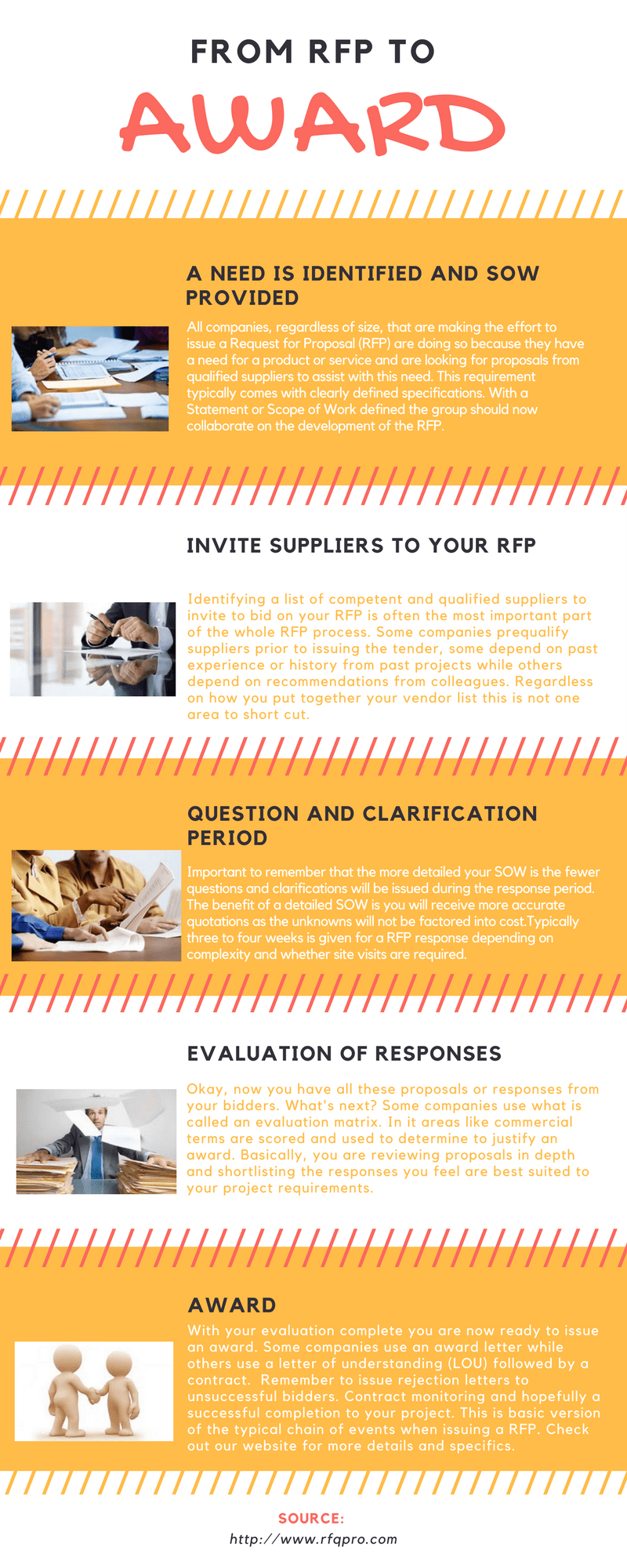
5 Step Summary – FROM RFP TO AWARD
Step 1 – A need is identified and SOW provided
All companies, regardless of size, that are making the effort to issue a Request for Proposal (RFP) are doing so because they have a need for a product or service and are looking for proposals from qualified suppliers to assist with this need. This requirement typically comes with clearly defined specifications. With a Statement or Scope of Work defined the group should now collaborate on the development of the RFP.
Step 2 – Invite suppliers to your RFP
Identifying a list of competent and qualified suppliers to invite to bid on your RFP is often the most important part of the whole RFP process. Some companies prequalify suppliers prior to issuing the tender, some depend on experience or history from past projects, while others depend on recommendations from colleagues. Regardless, of how you put together your vendor list, this is not one area to short cut.
Step 3 – Question and clarification period
Important to remember that the more detailed your SOW is the fewer questions and clarifications will surface during the response period. The benefit of a detailed SOW is you will receive more accurate quotations as unknowns will not be factored into cost.Typically, three to four weeks is given for a RFP response depending on complexity and whether site visits are required.
Step 4 – Evaluation of responses
Okay, now you have all these proposals or responses from your bidders. What’s next? Some companies use what is called an evaluation matrix. In it, areas like commercial terms are scored and used to justify an award. Basically, you are reviewing proposals in depth and shortlisting the responses you feel are best suited to your project requirements.
Step 5 – Award
With your evaluation complete, you’re ready to issue an award. Some organizations use an award letter and purchase order (PO), while others prefer a letter of understanding (LOU) followed by a formal contract.
Don’t forget to send rejection letters to unsuccessful bidders. After awarding, focus on contract monitoring to ensure smooth execution and, ideally, successful completion of your project.
This is a high-level overview of the typical steps involved in issuing an RFP. For more details on buyer and supplier solutions—including sample RFPs, response letters, and other useful forms—visit our website.
If you have found this information to be useful, please consider sharing this infographic on the 5 steps from RFP to an Award.