
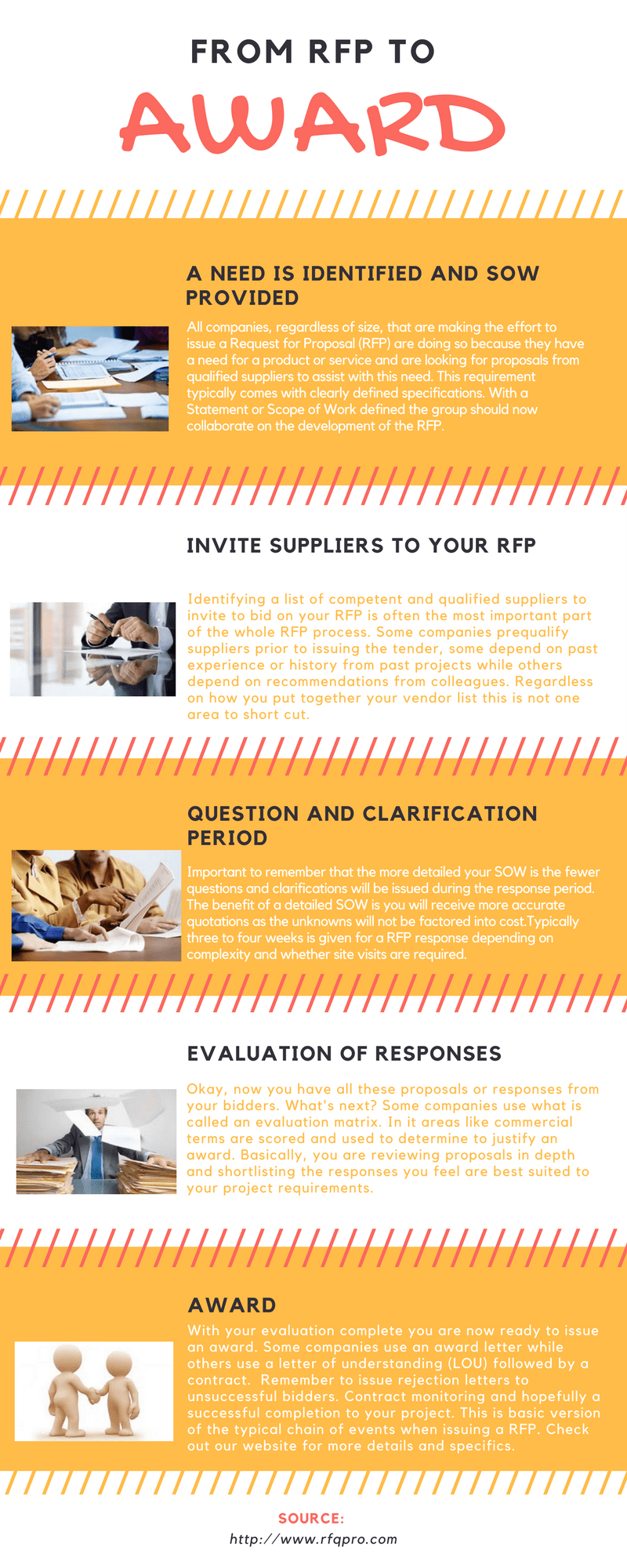
RFP Infographic

5 Steps from RFP to Award

Five key steps from issuing a Request for Proposal (RFP) to awarding the contract.

The Infographic below provides a clear, high-level summary of the typical chain of events that occur when issuing an RFP for a product or service.

Many organizations underestimate the complexity and time required to properly issue, evaluate, and award an RFP. Each step plays a critical role in ensuring a fair and successful process.

This visual guide to the five essential steps in the RFP-to-Award process is designed to offer practical insight on the process.  Hope it helps!

RFP Infographic5 Step Summary – FROM RFP TO AWARD

Step 1 – A need is identified, and Scope of Work (SOW) is provided.

All companies, regardless of size, that make the effort to issue a Request for Proposal (RFP) do so because they have a need for a product or service and are seeking proposals from qualified suppliers to address that need. This requirement typically comes with clearly defined specifications. With a Statement or Scope of Work established, the group should now collaborate on developing the RFP.

Step 2 – Invite suppliers to your RFP

Identifying a list of competent and qualified suppliers to invite to bid on your RFP is often one of the most important steps in the entire process. Some companies prequalify suppliers before issuing the tender, others rely on experience or performance from past projects, and many depend on recommendations from colleagues. Regardless of how you assemble your vendor list, this is not an area to shortcut.

Step 3 – Question and clarification period

It’s important to remember that the more detailed your SOW is, the fewer questions and clarifications will surface during the response period. A detailed SOW leads to more accurate quotations because unknowns are less likely to be factored into the cost. Typically, three to four weeks are allotted for an RFP response, depending on complexity and whether site visits are required.

Step 4 – Evaluation of responses

Now that you have all the proposals or responses from your bidders, what’s next? Many companies use an evaluation matrix, where areas such as commercial terms are scored and used to support the award decision. At this stage, you are reviewing each proposal in depth and shortlisting the responses that best align with your project requirements.

Step 5 – Award

With your evaluation complete, you’re ready to issue an award. Some organizations use an award letter and a purchase order (PO), while others prefer a letter of understanding (LOU) followed by a formal contract.

Award Approaches

  • Award Letter + PO — A straightforward method often used when the scope is well‑defined and standard terms apply. The PO serves as the binding document once accepted.
  • LOU + Formal Contract — Common for complex projects, multi‑year agreements, or situations where legal, commercial, or technical terms require detailed negotiation. The LOU confirms intent while the full contract is finalized.
  • Don’t forget to send rejection letters to unsuccessful bidders. After awarding, focus on contract monitoring to ensure smooth execution and, ideally, successful completion of your project.

This is a high-level overview of the typical steps involved in issuing an RFP. For more details on buyer and supplier solutions—including sample RFPs, response letters, and other useful forms—visit our website.

If you have found this information to be useful, please consider sharing this Infographic on the 5 steps from RFP to an Award.

Evaluating Spend

Evaluating your Spend

Evaluating Spend Every business, regardless of size,  should have a clear understanding on its operating costs and should be constantly evaluating this spend.

What Does It Mean to Evaluate Your Spend?

Evaluating spend means identifying where your money goes and whether you’re getting value. If you asked your accounting department to provide a list of the top 20% of vendors in relation to how much money you spend with them annually, this would be a start. This list of suppliers will represent close to 80% of your operating budget. I know, the Pareto principle is overused but in this instance is 100% on point.

Focus on the 80% That Drives Your Costs

Prudent business owners will dedicate a large portion of their time or their purchasing department’s time on analyzing this 80% cost. These are your target vendors and where you need to focus your efforts. Requesting price concessions for your guaranteed or long term business and suggesting that they partner with you on productivity improvements are two quick solutions you can key in on.

Drill Down Into the Details

  • First drill down and gather specific details on this spend. How many widgets am I buying of a specific product in a 12 month period? This is known as your annual usage. What is our cost to procure these items? Is there a better quality product which will perform the same function and reduce operating costs? Are there like vendors that can provide a similar material or service?

Lock in Pricing with RFQs and Contracts

  • Approach your existing vendor directly or by way of a RFQ and request firm pricing for a 12 or 24 month period. In exchange for this commitment, you are expecting preferred pricing. This does two things, stabilizes your costs for the next 12 – 24 months and reduces ordering costs as these commodities can be covered by a contract or supply agreement.

Create Competition to Achieve Fair Market Pricing

  • Creating competition is the best way to achieve fair market pricing for goods and services. To achieve this, you need to issue a Request for Quotation (RFQ) for the above item(s). If your spend warrants, you should do your homework and pre-qualify vendors for these items. Ensure they are of similar quality by asking for samples and get a sense whether these suppliers can meet price and delivery timelines based on your usage or existing requirements. No use buying something for 10% less than what you are presently paying if the new vendor cannot deliver!

Reduce Inventory Costs Through Vendor Commitment

  • It gives the vendor comfort knowing they have your business for the next 12 months in exchange for better pricing. By granting them a contract for the next year, the expectation is the vendor would guarantee they carry relevant inventory in their local branch which would then allow you to reduce on-hand inventory. In this instance you are reducing carrying cost, cash outlay for inventory and achieving a reduction in unit costs. Savings all the way around!

RFQs Signal Strategic Intent

Issuing a RFQ (Request for Quote) to determine present market pricing is always the preferred way of doing business. It is ethical, transparent and begins to condition your suppliers of your intention on monitoring your spend. It sends the message that your company is focused on ensuring you are receiving the best possible product at the best possible price.

If creating a RFQ to help manage costs is on your radar, there are many sample RFQ templates available on-line or the team at RFQPro would love to help you get the ball rolling.

See a list of our templates and forms by visiting our In the Pack Page

Here is to your success — Mark.

Stressed out supplier - RFP Response

The Dreaded RFP Response


Stressed out supplier - RFP ResponseAs a vendor or supplier of product or services, one of the biggest challenges in today’s marketplace is finding the time to respond to the constant stream of information requests arriving in your inbox each week. Your responses need to be professional, representative of your organization, accurate and detailed enough to ensure you are shortlisted for potential projectsThese information requests may include price and delivery inquiries, product specifications, tenders or quote requests, and-most time-consuming of all-the dreaded RFP response which is likely the most time consuming task out of all the inquiries presently filling up your inbox. RFPs continue to rise in popularity because many organizations now use them as a catch all tool for handling internal requirements submitted to the purchasing department.

When the purchasing team doesn’t receive a clear scope or specification, they often issue an RFP in hopes that a vendor will propose a solution. What is frequently overlooked by the Buyer is the amount of time and effort required for the Vendor to prepare a strong RFP response. You can’t blame them—purchasing teams have their own fires to put out—and most suppliers accept that responding to a request for proposal is simply a cost of doing business. Can you reduce the cost of responding to RFQs and RFPs? Yes and no, and we’ll address that shortly.

As a vendor you should keep track of your success rate and the approximate cost of preparing your response. If you are spending $10,000 to submit a response and being awarded a $150,000 contract then you can clearly justify your ROI. If you are spending the same $10,000 to be awarded a $15,000 contract then not so much unless it leads to further work or a long term relationship with a new client.

I am not sure most companies can answer how much it costs to deliver a RFP response or tender call however I do know that if they can find a way to do this quicker, save money and achieve better results then everyone would consider doing it. Having a clean versus cluttered response is a start and taking the time to have more than one person review the RFP request are two solid ways of improving your chances. While every RFP response requires a unique approach, many components can be standardized.

Your company references, testimonials, company bio, contact coordinates, past project successes, financials, safety and equipment lists can be prepared ahead of time. Other areas like your cover letter can also be saved in a format which allows you to tweak and go. All these pieces will help you get your responses out quicker and quicker means cheaper.

Since 2008, RFQPro has been helping both Buyers and Suppliers succeed with the request for quote and request for proposal process by providing web-based RFQ Software and editable procurement related word templates to help users expedite this process and improve departmental productivity. Why start from scratch? Visit the RFP Response Page for more details.