
How Effective are your RFP’s? (3 Key Indicators)

How Effective are your RFP’s and the three key indicators to measure to help you improve.

That is the question—and unfortunately, many professionals don’t have it on their radar. We often roll these documents out the door without realizing how ineffective they are, or how much time we may be wasting by not achieving the desired result.

Request for Proposals (RFP) have become the go-to purchasing or procurement tool. Their use is on the rise as more companies rely on them for virtually all procurement needs and project work-period. Whether an RFP is the right tool for the task at hand is another blog post altogether! In this post, we’re going to help you produce a more effective RFP by outlining three key indicators to measure when issuing one. Follow these steps and you’ll be far more likely to achieve the desired results while using the least amount of resources. 

To get right to the point: you’ll save time, money, and energy by focusing on the content you include in your RFP. Strengthening—and selecting—the right content dramatically increases its potential for success.

What determines the correct content and effectiveness of the RFP are identified in these 3 key indicators below:

  1. Clarification Requests – If you are spending time responding to tons of the same questions asked by more than one of the bidders then the correct content or scope of work was unclear. So, the first key indicator which will help you determine how effective your RFP is would be the number and types of questions your supplier’s are asking during the response period. Could you have provided this information as part of the original Statement of Work or maybe some of the other deliverables were not detailed enough.
  2. Vendor Responses – The actual number of quality vendor responses received is the second key indicator.  YES, responding to a RFP is expensive and vendors will put in the effort to provide a quality response if the deliverables are clear. A win for both parties.
  3. Competitive Quotations – The prices quoted by your vendors is the third and possibly the most important indicator and YES, this will be a factor. If your RFP content is clear, the quoted prices will reflect this. Removing unknowns will reduce project costs.
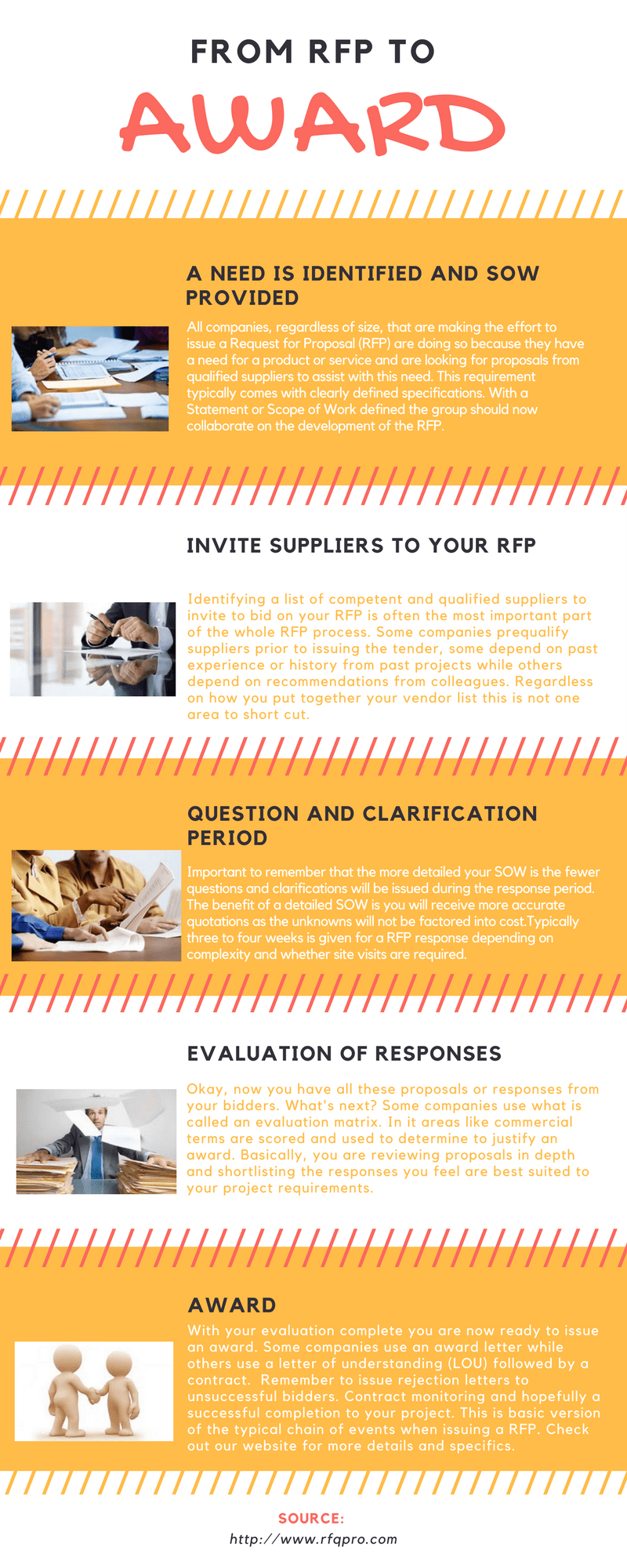

RFP Infographic

5 Steps from RFP to Award

Five key steps from issuing a Request for Proposal (RFP) to awarding the contract.

The Infographic below provides a clear, high-level summary of the typical chain of events that occur when issuing an RFP for a product or service.

Many organizations underestimate the complexity and time required to properly issue, evaluate, and award an RFP. Each step plays a critical role in ensuring a fair and successful process.

This visual guide to the five essential steps in the RFP-to-Award process is designed to offer practical insight on the process.  Hope it helps!

RFP Infographic5 Step Summary – FROM RFP TO AWARD

Step 1 – A need is identified, and Scope of Work (SOW) is provided.

All companies, regardless of size, that make the effort to issue a Request for Proposal (RFP) do so because they have a need for a product or service and are seeking proposals from qualified suppliers to address that need. This requirement typically comes with clearly defined specifications. With a Statement or Scope of Work established, the group should now collaborate on developing the RFP.

Step 2 – Invite suppliers to your RFP

Identifying a list of competent and qualified suppliers to invite to bid on your RFP is often one of the most important steps in the entire process. Some companies prequalify suppliers before issuing the tender, others rely on experience or performance from past projects, and many depend on recommendations from colleagues. Regardless of how you assemble your vendor list, this is not an area to shortcut.

Step 3 – Question and clarification period

It’s important to remember that the more detailed your SOW is, the fewer questions and clarifications will surface during the response period. A detailed SOW leads to more accurate quotations because unknowns are less likely to be factored into the cost. Typically, three to four weeks are allotted for an RFP response, depending on complexity and whether site visits are required.

Step 4 – Evaluation of responses

Now that you have all the proposals or responses from your bidders, what’s next? Many companies use an evaluation matrix, where areas such as commercial terms are scored and used to support the award decision. At this stage, you are reviewing each proposal in depth and shortlisting the responses that best align with your project requirements.

Step 5 – Award

With your evaluation complete, you’re ready to issue an award. Some organizations use an award letter and a purchase order (PO), while others prefer a letter of understanding (LOU) followed by a formal contract.

Award Approaches

  • Award Letter + PO — A straightforward method often used when the scope is well‑defined and standard terms apply. The PO serves as the binding document once accepted.
  • LOU + Formal Contract — Common for complex projects, multi‑year agreements, or situations where legal, commercial, or technical terms require detailed negotiation. The LOU confirms intent while the full contract is finalized.
  • Don’t forget to send rejection letters to unsuccessful bidders. After awarding, focus on contract monitoring to ensure smooth execution and, ideally, successful completion of your project.

This is a high-level overview of the typical steps involved in issuing an RFP. For more details on buyer and supplier solutions—including sample RFPs, response letters, and other useful forms—visit our website.

If you have found this information to be useful, please consider sharing this Infographic on the 5 steps from RFP to an Award.

RFP truck services

RFP for LTL Freight Services

RFP truck servicesSelecting a freight broker or transportation service provider is one of the most important decisions you will make for your organization, especially when issuing an RFP for LTL Freight Services or evaluating carriers for time‑sensitive shipments. Why? Because when orders aren’t delivered on time, suppliers risk losing customers, and buyers face production delays that quickly translate into profit loss. Like it or not, LTL freight shipping, carrier performance, and freight management services can make or break your business, and they remain an integral part of a resilient supply chain.

The Bureau of Transportation Statistics in the USA reported that the trucking and transportation market on a typical business day ships approximately 43 million tons of merchandise, valued at about $29 billion, moved almost 12 billion ton-miles on the nation’s interconnected transportation network.  These statistics imply the significance this industry sector has in regards to transporting our goods. In fact, if it is shutdown for any period it can cripple a country and your business.

Designing a request for proposal for Less than Truckload (LTL) services might include some of the following details:

SAMPLE SCOPE OF WORK for your RFP for LTL Freight Services:

The estimated annual LTL tonnage is approximately _______________million pounds (_,000,000) including inbound, outbound interstate and intrastate shipments.

The Following is a historical comparison of volume of freight shipped for the last five years:

2006     – 1,899,820 lbs.
2007     – 2,237,577 lbs.
2008     – 2,243,635 lbs.
2009     – 2,911,596 lbs.
2010     – 2,879,598 lbs.

The stated tonnage in this RFP is not a guarantee of a specific number of shipments or total volume. The Shipper does not guarantee to ship any specific number of LTL shipments, i.e., no minimum annual volume.

The above scope of work provides your bidders a very good indication of expectation.  From this they can determine the equipment, manpower and overhead required to service this contract if they were awarded the business. Providing historical data is an excellent way to estimate your anticipated shipments and as always provide a clear disclaimer about guarantees.

Other areas you might include in your RFP would be tracking capabilities, routing or coverage areas, specific details on their fleets, facilities and equipment. Ask about fleet size and ownership, do they sub-contract work (independents). This may not be a deciding factor but knowing whether an actual employee of the freight company or an independent contractor is transporting your goods is a fact you should be aware of.

When it comes to due diligence items, you might request a copy of their Spill Response Plan, Emergency Response Plan, do they employ a safety coordinator, safety records, insurance and damage claim history are good questions to clarify.  To purchase our RFP for LTL Freight Services – Template #90 is in both our Premium and Mega Packs.

IncoTerms Post helpful for clarifying transportation responsibilities, clearance, insurance and documentation.

Related postFOB Points go hand in hand when it comes to shipping freight services.